


EVs are fixing the broken economics of taxis
EV technology is reviving an unexpected industry in Indonesia
A decade ago, upon landing on Jakarta’s International Airport you would have been greeted by a handful of taxi brands waiting outside of the terminal. Some would be white, but most were probably blue, donning the fittingly named “Blue Bird” logo. Blue Bird had long held market dominance; in 2016 the company held a 50% market share in the conventional taxi business, and two years prior the company had gone public with an IPO of $400 million.
However, as with every taxi industry all over the world, the introduction of ride-hailing services had weakened the grip of conventional taxis in the market. This, combined with the pandemic, had resulted in Blue Bird reporting a $9 million loss in 2020, compared to the previous year’s $18 million in revenue, while mounting debt amounted to over $130 million. This, however, was far from the worst of the bunch, Express Taxi, its main competitor, filed for bankruptcy during the same time period. Their stock had been suspended in 2018 following a brief battle against ride-hailing taxi competitors.
From there onwards, Blue Bird was the only taxi you would see roaming the streets of Indonesian cities. While there were small local players, none were meaningful enough to write home about. Express Taxi wasn’t the only casualty of the online taxi boom; the price war between Singapore’s Grab and local hero Gojek, the two largest ride-hailing platforms, had also driven Uber out of the Indonesian market. The battle was so unforgiving that the government had to step in with antitrust laws to prevent a potential monopoly in the case of bankruptcy of either firm.
For a while, Blue Bird was seemingly enjoying a ‘good enough’ monopoly in the conventional taxi market. The company targeted a different demographic compared to Grab and Gojek (often more premium and dominated the upper-class neighbourhoods), and conventional taxis are treated differently in Indonesia, owing to privileges like exemption from even-odd traffic rules, special permission in hotspots like airports and tourist areas, and being allowed to pick up curb side passengers. This was until 2024, when a Vietnamese company called Xanh SM announced they would have their go at the Indonesian taxi market. This was a surprise to many, as no one thought there was room for anyone other than Blue Bird in the market. Inflation, rising costs for maintenance, and the instability of fuel prices make the economics of taxis almost impossible.
Many, like Express Taxi, had failed, and Blue Bird struggled to regain momentum; it was an interesting decision to enter an already saturated market. However, Xanh SM had tricks up their sleeves. Most notably, their fleet consists of 100% electric vehicles, they are also painted in a distinct cyan livery, making them easily recognizable by the public. Oh, and another thing: they build their own cars.
Xanh SM, which would later be renamed Green SM for easier pronunciation, is a company owned by Vietnamese billionaire Phạm Nhật Vượng, whose company Vingroup also produces their own EVs under the VinFast marque. Mr. Vượng started his EV business in 2017 after becoming successful in the instant noodle business; this time he wanted instant success in the EV industry, managing to build working prototypes in under two years. His cars, however, did not sell like hotcakes unlike their Chinese counterparts. VinFast was continuously losing money as they had to sell what units they could at a loss to the public. Mr. Vượng then came up with the idea of selling their own cars to themselves and using them for taxi fleets around the world. The subsequent taxi operations would then enjoy a plethora of comforts compared to legacy taxi companies, mainly the relatively low fuel and maintenance costs, which for EVs are almost non-existent. This would help both VinFast, the automaker, and Green SM, the taxi company, enabling them to set lower prices and minimize share cuts between them and the drivers.
With a 100% electric fleet and full control of the supply chain, VinFast seems to be growing in Indonesia. Another revolution in the taxi industry that has also benefitted Green SM is the driver-ownership scheme, a scheme where taxi drivers can work towards owning the very car they drive for work. This scheme is what made Blue Bird shift from a majority sedan fleet to an MPV-based one, as the second hand market for MPVs is healthier than sedans and more drivers are interested in them, creating an incentive for drivers to join the company. With the promise of electric cars and the low maintenance cost that goes along with them, driving for Green SM might be more enticing for drivers who are interested in owning a car through the ownership scheme. This seems to be a major part of their strategy, as Green SM is actively advertising the fact that drivers are allowed to “bring home” their company-provided car. In a shock to many, Express Taxi has also been rumoured to make a comeback with a fully electric Citroen C3 fleet.
Grab and Gojek have also been enjoying the EV revolution in the form of the BYD M6. The electric car is a great alternative for their premium offering, which had previously been utilizing diesel-powered cars like the Toyota Innova. With the BYD M6, drivers are better positioned, as they have to pay less for maintenance and fuel. Lower overhead also allows more flexibility to service both the higher-paying premium service and the lower-margin “regular” tier when premium passengers dry up. With diesel or gasoline equivalent cars, they might only be able to work within premium margins, making the economics impossible. This might be the reason why the M6 was the second best-selling EV in Indonesia during 2025; a significant portion of that was by firms who would rent them out daily to drivers. Both Grab and Gojek have recently reported net profits after years of sustained losses.
The Indonesian taxi industry is expected to grow by 7% year-on-year until 2031. Blue Bird reported an 11.5% increase in net income during the first quarter of the year. It is no wonder why newcomers and veterans are increasingly interested in the industry. But the extent of EVs’ role in the industry remains to be seen. Mordor Intelligence reported that, as of now, more than 99% of taxis in Indonesia are still gas-powered. One major concern for taxi companies building their fleet is resale value, Blue Bird usually keeps its fleet for 6 years before retirement and sells them at a big discount after being refurbished. Regular-use EVs on average loses up to 50% of their value after 5 years of use. It is still unknown how the used market for ex-taxi EVs will affect taxi companies in the long term, especially those who rely completely on EVs.
However, taxi companies should proceed with caution. Blue Bird is diversifying their lineup, citing a focus on expansion in the “non-taxi segment,” which makes up 30% of their revenue. Express Taxi’s comeback is yet to be seen en masse, and Green SM has recently gone under scrutiny for alleged inadequate training for their drivers, causing highly publicized accidents, including one which led to a train crash that resulted in 16 deaths after one of their taxis got stuck in the middle of a train track, causing a domino effect. Grab and Gojek executives are also not afforded sanguinity after President Prabowo announced a Presidential Decree mandating ride-hailing companies to provide drivers with work insurance, holiday aid (Tunjangan Hari Raya), and an 8% cap on the maximum take rate for the firms, down from 20%. This is all part of his recent Labour Day speech. The details of the decree are to be finalized, and as with the fate of the Indonesian taxi industry, it’s unknown what will come out of it.
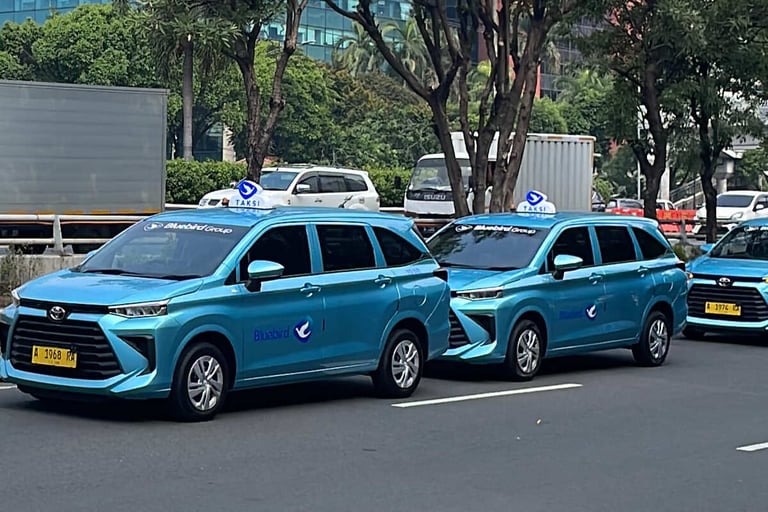
BlueBird Taxis driving the streets of Jakarta, Image: BlueBird
The Little Economies Project
Editorial Board
david.danieli@littleeconomies.com
Press & other inquiries
Jakarta
(C) 2026 Little Economies
KONTEN KAMI ADALAH BUATAN MANUSIA. BUKAN AI.