


The Changing of Guards at the Indonesian Automotive Industry
The tide is changing in 2026, those who ride it, will win.


The fresh smell of welded steel is something few people would like to experience while walking in the evening, but for me it was just exactly what I came across in my neighborhood. The smell was coming from a construction site where workers tigs away behind makeshift wooden fence at the grounds of what would be a dealership and the future headquarters of the Indonesian automotive brand, Aletra. The brand was introduced to the Indonesian market in late 2024, they have since built a few smaller dealerships and sold a few cars during 2025, a figure that is just shy of 300 units.
Vis-à-vis to the construction site, another dealership stands tall. This one however, was already up and running and has been for about as long as Aletra was introduced as a brand, it’s modern and futuristic façade is probably not what you would expect a car dealership to look like. But this one was out of the ordinary, it seemed modern and futuristic proudly with it’s name fixed on the side, BAIC. The acronym stands for Beijing Automotive Industry Corporation, and as the name would suggest the brand has it’s roots in Beijing, China.
Within a few minutes drive, you would be able to find other Chinese EV dealerships from the likes of BYD, Geely and Jaecoo, none of which was there just 3 years ago. In contrast, Subaru had just recently closed one of it’s largest dealership in the area, pre-dated by Nissan who had done it years earlier. Toyota have significantly more dealerships than BYD or any other Chinese automakers, but on average a BYD dealership would sell more cars than the average Toyota by more than 52%.
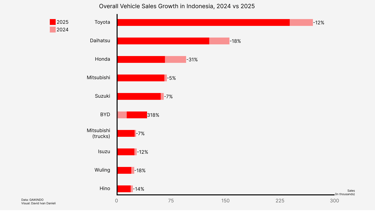
These Chinese automakers have more in common than just the area of their HQ, their spearhead is in the Electric Vehicle technology and not Internal Combustion Engine. The Aletra L8, is a rebadged version of the Maple 80V, a 7-Seater EV that is developed by the Chinese automaker giant, Geely. Another thing they have in common is their uncanny expansion attempts in the Indonesian EV market, going against legacy automakers like Toyota, Honda and Hyundai. On the surface, the status quo has not changed, throughout 2025, top five of the best-selling brands are Japanese and they make up more than 60% of overall sales. The automotive industry experienced a 7% decline from during the same period, Honda suffered the most with a 30% decline. In the top 10 rankings only one brand managed to achieve growth at a staggering 300% rate, that outlier is BYD (see chart).
Illustration: Gariz
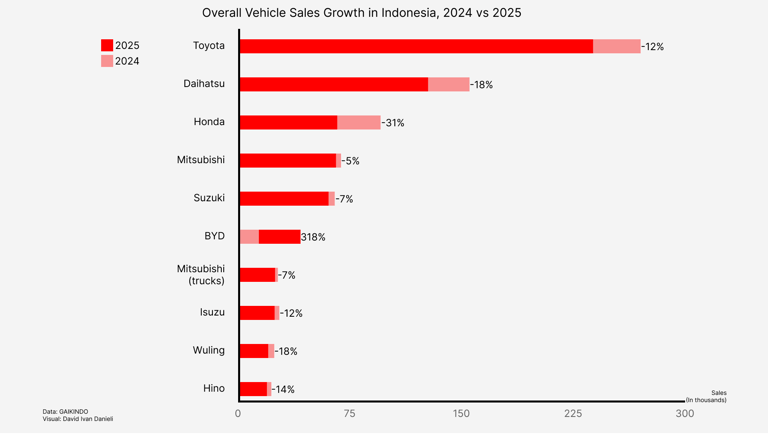
However, Chinese automakers are chipping away slowly and the evidence is clearer when you look at the EV sector. In 2025, BYD - which is 6th on the overall list - sold more EVs in Indonesia than any other automakers combined, and when including it’s luxury subsidiary Denza, managed to achieve 55% market share in EV sales. This growth comes in the expense of Hyundai, a South Korean automaker with a local assembly plant that produces the Ioniq EV lineup with which it managed to achieve 95% market share in 2020, 5 years later the number was much less impressive at 2%. BYD is not the only culprit behind the declining Hyundai EV sales, other Chinese automakers like Wuling and Chery have also contributed to the massive Headache for Hyundai executives.
Panic goes beyond, Toyota which sells the famous hybrid Alphard luxury minivan felt pressured by the presence of the not-so dissimilar Denza D9, a car that gives the Alphard a run for it’s money for only half of it. In response Toyota introduced a ‘budget’ version of the luxury minivan which reduces the selling price by about 300M Rupiah to 1.4 Billion, which is still far from the Denza D9’s selling price of 950M Rupiah but still is a price adjustment worthy of note. The Denza MSRP was made possible partly due to the significant tax breaks granted by the Indonesian government for EVs until the end of 2025, the absence of VAT, luxury and road tax gave EVs in Indonesia significant advantage over ICE vehicles who still had to deal with considerable levies even if they are made in Indonesia.
Beyond 2026 the EV tax breaks are no more, although still favoring locally assembled EVs and Hybrids. Plans are underway for EVs and hybrids with an MSRP of under 375M Rupiah getting exempt from paying the luxury tax, and those who uses Lithium-Ion batteries – which contains the strategic mineral of Nickel – may enjoy a further tax relief. However for the latter, it is an incentive few will enjoy, as in 2025 84% of EVs sold does not use batteries that contains the mineral that would help them qualify. For the former though, it can spell even further danger to legacy automakers if the proposed scheme is implemented.
Chinese automaker’s venture into the Indonesian market is dominated by the EV technology, most apparent with BYD whom currently does not offer a Hybrid or pure Gasoline vehicle for purchase. The current hybrid market is still dominated by Toyota which many recognize as the best in class for the technology. With how the new incentives are set up however, things are about to change. In Europe, BYD already sells more hybrids than they do EVs, this is due to how the European Union implements tariffs on Chinese electric vehicles. Which varies in severity considered by the EU in how much each firm receives “unfair subsidies” from the Chinese Government, Hybrids do not fall under such tariffs and therefor are free to fight in the heavily contested European market.
While EVs still make up the bulk of Chinese export, Hybrids are playing catch up and it’s only a matter of time before those hybrids starts landing on Indonesian ports. BYD managed to be 6th on the overall list while only selling EVs, this is despite EV sales only making up 12% of total automotive sales in Indonesia in 2025. Once BYD starts combining ICE and Batteries, it is sure to ruffle some feathers in the market and climb up the ranks.
Ironically, the growth of many Chinese automakers in Indonesia is facilitated by a local company which once had a close relationship to Hyundai, PT. Handal Indonesia Manufacturing (PT.HIM) once assembled cars for Hyundai’s lineup before the South Korean automaker set up it’s own plant and parted ways with PT.HIM in 2020. PT.HIM then pivoted it’s business model acting as a general assembler for a mix of Chinese automakers. With locally assembled EVs, these automakers can get around import taxes for automobiles with models meeting a minimum locally made component threshold (TKDN). BYD however, is going a step further by building a giga factory-esque plant in West Java, this manufacturing capability combined with a hybrid vehicle offering in the future will set it’s foot in the Indonesian market even deeper.
Spy images of BYD’s M6 Hybrid, a version of it’s best selling EV have been going around since late 2025, BYD is unique in Indonesia in the way they skipped Hybrids completely, unlike many automakers who steadily transitioned from ICE vehicles to hybrids, then pivoting towards full EVs. This late pivot towards hybrid technology is not only popular with Chinese automakers, other legacy automakers are also feeling the pressure. In early March, executives at Mitsubishi reiterated their intention to also launch a hybrid model in the Indonesian market. Toyota, Mitsubishi and Honda have long been the undisputed market champions, becoming household names for many Indonesian families synonymous with reliability and strong resale value. However, they are losing ground in an already slowing market and launching cheaper models of their premium offerings will not be popular amongst their customers. Now buyers are starting to pivot towards Chinese EVs, but once the growth inevitably slows down, hybrids are ready to catch the slack. They are preparing for this by investing in production and dealerships even during economic uncertainty and market slowdown.
On the surface it may seem like Chinese automakers are set up for success, but not everyone is a winner. Competition is stiff both in Indonesia and back home, Neta – a Chinese EV firm – closed 12 of their dealers after only about a year of opening their first one, leaving only 2 in operation by the end of 2025. They have also ceased operations in Singapore, the competitive EV market in China may have prepared them to fight on the global stage but it can also be of curse. Chery, the parent company of JAECOO have been rumored to subsidize their model lineup to cover the cost of the popular JAECOO J5 which retails for just under $15,000 with margins some suspect they cannot maintain for long as levies go into effect.
While the Indonesian automotive market did not see wide-spread hybrid adoption prior to EVs entering the market, hybrid competition is coming ahead and how legacy automakers respond will decide their future, and they have some advantages, but they are degrading fast. Many still consider legacy Japanese brands as having the best reliability and customer support amid declining skepticism against Chinese rivals. In this case they have an advantage on negativity bias, if a customer complains of Chinese vehicles having problems it will sure catch more attention compared to if the same happened to a vehicle from a legacy Japanese brand. They are still seen to have better reliability and efficiency in their conventional ICE technology, an integral part in a hybrid. And then there are also factors that Chinese automakers are unable catch up in just a few short years, supply chain for original and aftermarket parts is also something that most people consider when buying a car in Indonesia, and the Japanese have had decades of this ingrained in the system.
EV growth all over the world is slower than expected, and it will also be the case in Indonesia. The storm is brewing and hybrids are coming to the market, how legacy automakers like Toyota play this one out will be the deciding factor in the market for years to come. Chinese automakers that enter the global stage are known to be fierce players, they have survived in the bloodbath that is the Chinese market. In the end, innovative products, focus on software and new concepts that did not exist previously all while lowering prices are sure to benefit end consumers. We predict that a 12% EV adoption rate in Indonesia is nearing it is peak and we expect a flurry of hybrids to join the fight soon, but this time, Toyota might have a chance to win.
The Little Economies Project
Editorial Board
david.danieli@littleeconomies.com
Press & other inquiries
Jakarta
(C) 2026 Little Economies
KONTEN KAMI ADALAH BUATAN MANUSIA. BUKAN AI.