


Japanese automakers have yet to learn from their mistakes.
they might want to hire a chief common-sense officer.
LITTLE BIG STORIES
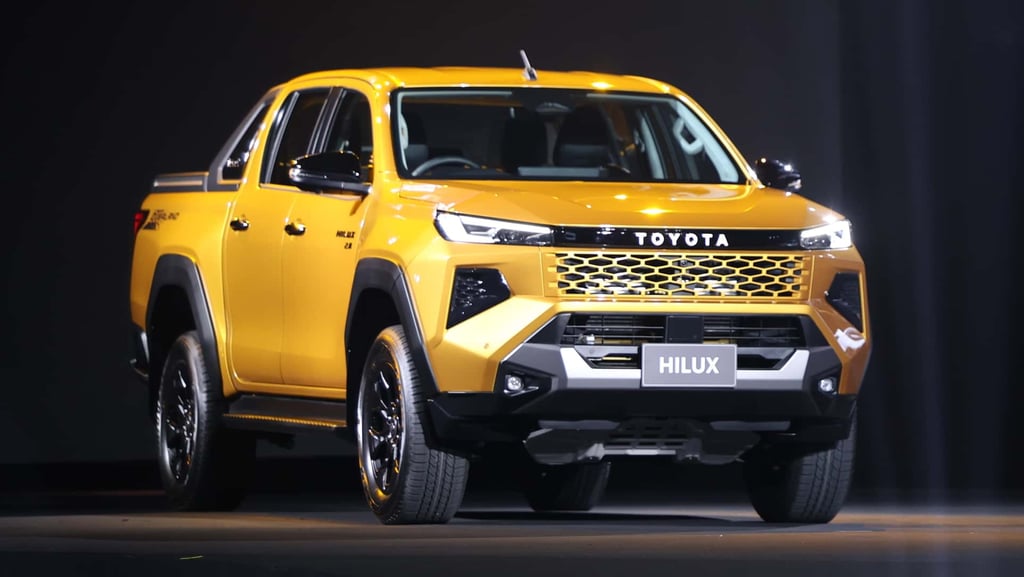
Image: Toyota
Earlier this week, Toyota Astra Motor announced their newest vehicle offering in Indonesia, the All-New Toyota Hilux. The Hilux has long been known as a workhorse of a car. Top Gear, a famous motoring show from the UK, has even sailed one off to the sea, and miraculously revived the engine after it had been submerged for approximately 5 hours. This new generation of Hilux, however, will go down in history in a different way, because along with the standard diesel-powered offerings, the Hilux is now available with a fully electric powertrain.
On the surface this may seem like a reasonable move by Toyota, electrification seems to be the way to go, after all. But the release of the new electric Hilux stands for everything that is wrong about the Japanese automotive industry. Toyota has not learned from its own mistakes, nor from others'. In 2025, Toyota only offered one EV model in the Indonesian market, of which they did not manage to sell more than 80 units. A number so low that it does not even make up 1% of total EV sales.
And it's not because people are not buying EVs in the country, 12% of all new cars sold last year were EVs, they were just not buying Toyota's. This is due to the fact that the only model they offered, the BZ4x, is way too expensive at a staggering MSRP of 800 million Rupiah, while the average price of EVs sold last year was just shy of 450 million. That number has since dropped further, as in Q1 2026 the average price decreased to just below 400 million.
You would think that Toyota would learn from its mistakes and release an EV with a price that actually fits the market, the Hilux is not a luxury vehicle, after all. But when they revealed the price, it was clear that Toyota was not planning on selling any of these, as the MSRP came in just over 1 billion Rupiah. Yes, one billion with a B. This is despite prior efforts from the company to launch a cheaper EV model at the beginning of the year with the "Urban Cruiser EV" at 759 million Rupiah, still not a cheap vehicle, but one that is on the right path.
If Toyota has not learned from its own mistakes, maybe they could perhaps learn from others'? Not exactly. This concept, electric pickup trucks, has been tried previously by Ford with the F-150 Lightning. Once boasted as the future of the F-Series nameplate, it was in production for only about 3 years before being discontinued completely. Sales figures vary between 70,000 and 100,000 units (about 20,000 units each year) depending on the source, but any estimate falls far short when you consider that the regular, gas-powered F-Series has consistently sold more than 700,000 units annually. The failure of the F-150 Lightning was caused by low demand as truck owners are not exactly the type of people who get excited about batteries over V6 and V8 engines. It's also because EVs are, as it turns out, really bad at handling extreme weather, really bad at towing, and really bad at heavy lifting — all of which are criteria that makes a good truck.
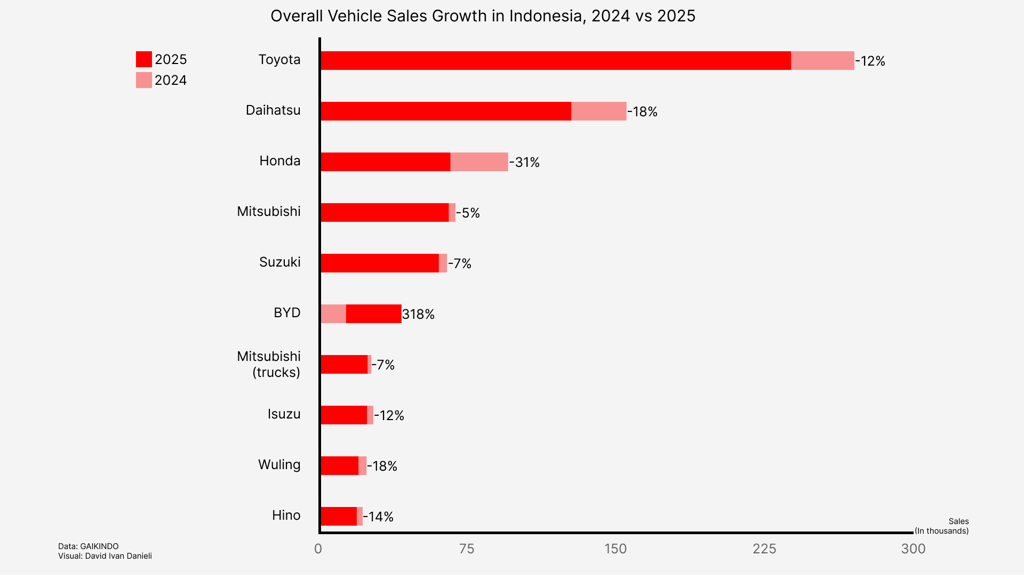
Toyota then has not learned from anyone’s mistakes and they have every reason why they should. Last year, 9 of the top 10 best-selling automakers in Indonesia saw their sales decline. The one outlier was BYD, which sold over 300% more cars than it did the year prior. BYD exclusively sold EVs last year, and its growth comes at the expense of Japanese automakers. Honda was hit the hardest, with its sales declining 30%, and 8 of the other 9 automakers on the list are Japanese. Wuling was the only other non-Japanese automaker on the list. (see chart)
And it's not just Toyota who’s being stubborn. In late 2024, Mazda officially entered the EV market in Indonesia, becoming the 2nd Japanese automaker to do so. Their effort, however, is just as poor. The MX-30 only offered 200km of range while the industry average was 390km, and it was also priced egregiously at 860 million Rupiah. It's unclear how many they sold last year, but it was probably near zero.
Honda is not doing any better. The only EV they offer to date, the e:N1, did not sell any units last year, mostly because you can't really buy one. The only way to get your hands on one is by renting it directly from Honda at 22 million Rupiah a month, meaning over 5 years you would end up paying just over 1.3 billion Rupiah for a car you don't even own.
There is a reason why even the "king" of EVs, BYD, does not have a fully electric pickup. The BYD Shark 6 is a plug-in hybrid and has gone on sale in markets such as Australia, where it has fared well and became Australia's best-selling plug-in hybrid of all time. Had the pickup been fully electric, the story would surely be different.
Making the Hilux fully electric comes with more downsides than just sales numbers. Vehicle platforms designed to accommodate both an electric powertrain and a conventional combustion engine have traditionally required tradeoffs that affect both versions such as smaller cabin size, worse space optimization for battery or engine placement, compromised structure, and added weight. It also costs more to develop, and most major automakers are pivoting away from this approach, focusing instead on purpose-built EV platforms to avoid such compromises. This is why the all-electric BMW i4 does not have a front trunk, a major selling point of EVs, as the space where a frunk would normally sit is reserved for an engine in the gas-powered 4 Series. The electric Hilux similarly does not feature one.
It's easy to say that it's not all doom and gloom for legacy Japanese automakers, as some brands are starting to adapt to this new order. Mazda is expected to announce its EZ-6 electric sedan later this year, replacing the outgoing Mazda 6. The new model has potential to be competitive, as it is the result of a joint venture between Japan's Mazda and China's Changan. The car itself is essentially a Changan Deepal 07 with Mazda styling. It also has an EREV variant, and if introduced into the Indonesian market, would be the first model to feature the technology. But the Mazda EZ-6 is a premium vehicle, so its MSRP will be significantly higher than the average EV. It's also a sedan, a form factor that is not highly sought after in the Indonesian market. It's a promising start, but we have yet to see Japanese automakers truly learn from their mistakes.
The Little Economies Project
Editorial Board
david.danieli@littleeconomies.com
Press & other inquiries
Jakarta
(C) 2026 Little Economies
OUR CONTENTS ARE HUMAN MADE. NOT AI. EVER.